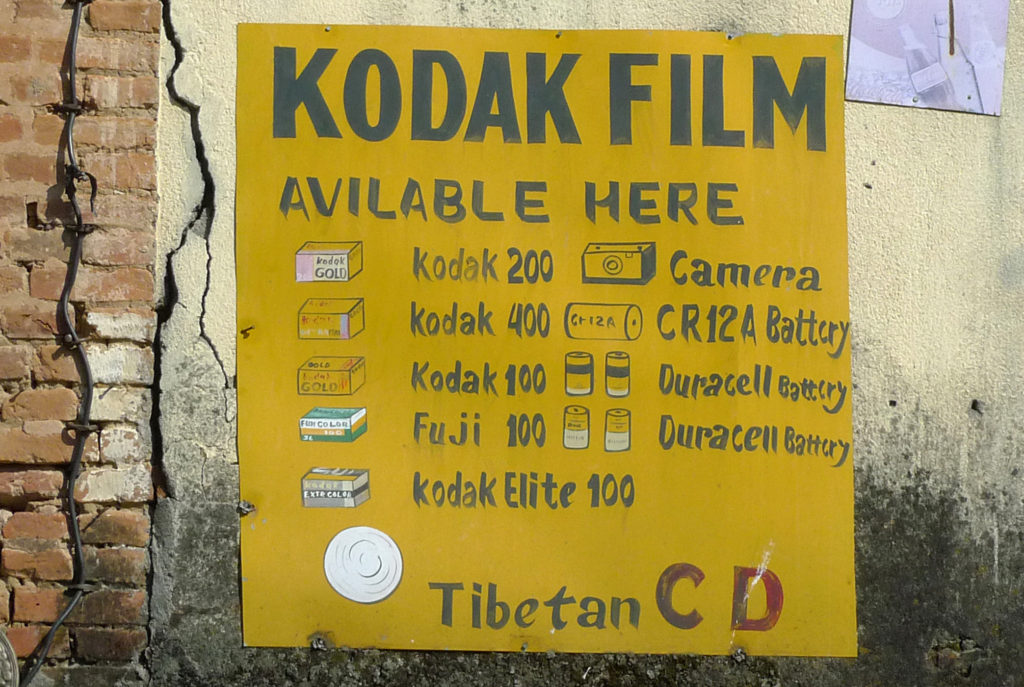
I have recently abandoned digital photography and will sell all my digital cameras. Andreas Gurski shoots film and earns millions, so there must be convincing arguments.
- Digital cameras are technically outdated within three to four years. My Linhof camera and Rodenstock lenses are 30 years old and I could sell them for more than I paid. The Kadak Retina IIIa that my father gave me when I was ten, still takes better images than a 47 MP DSLR.
- With digital, you feel like reshooting your best images every five years, because the image quality keeps improving.
- With film, your entrance ticket to that medium-format look is very low. A Hasselblad sells for $ 500 on eBay, while a Phase One costs $ 50 000. This buys you a lot of film. If you are new to film, you can neglect the cost of cameras and lenses.
- Shooting film, you will learn that gear doesn’t matter. You don’t have to worry about lens micro-contrast and their MTF because all lenses are good enough for film.
- Film has a very natural shoulder in the highlights. This delivers beautiful dark shadows with no texture and lets you shoot right into the sun.
- Film grain is organic, while digital noise is ugly. Film images just look more organic. With film, you don’t have to worry about white balance. Film has a color depth of 10000000 bits and, therefore, much better color separation.
- Digital is just 0 and 1, chemicals are everything in-between.
- Film works great for long exposures lasting hours, such as capturing star trails. Because of the low sensitivity and small aperture needed for large-format film, you don’t even need to carry neutral-density filters.
- Film slows you down, so you think more and your keeper rate is higher. Because each image matters, you only set up for what it’s worth. This is better than running around like a tourist with a camera around your neck. The larger the film size, the less you shoot, which in turn increases the keeper rate even further. There is no need to go through thousands of shots after a vacation, blocking terabytes on your hard disk.
- There is no worry about the second card slot or cards failing. The film doesn’t become unreadable, and there are no file compatibility problems.
- Burglars may steal all your computers and storage devices but they will not steal the film-storage cabinet.
- There is no battery needed. On a cloudy day, I shoot f/22 at 1/8 of a second. I don’t even need a light meter.
- On a film camera there are the aperture and exposure-time settings; that’s it. There is no need for a third-party user’s guide to figure out all the dials and buttons, and how to configure the camera menu. There is no risk of losing the shot, because you are on the wrong shooting bank.
- There is no need for carrying a laptop and all the chargers, dongles, connection cables, backup drives, cases, and other junk required for the digital workflow.
- There is no distraction by checking images on the DSLR’s monitor (vulgo chimping). You will not miss the million-dollar shot just because you were looking at a tiny screen.
- The reviewing and curating of images is deferred to a few weeks after the vacation, which provides the joy of anticipation. Having everything at your hands instantly makes you lazy, whereas waiting lets you develop patience.
- Keeping unexposed film in the fridge or freezer lets you store less unhealthy food. This improves your photography and reduces your BMI.
- It’s better to shoot $1000 worth of film instead of 10,000 images, and it’s better to look at images than at megapixels.
- Film shooting is more about images than showing others your equipment (in particular these long “compensator” lenses).
- Film photography treats images as individually important, they become precious and mean something to you.
- A whole new generation has become interested in film; they want something tangible. Shooting films brings you together with young people.
- Setting up a view camera brings you into contact with people. Their first question usually is: WtF is this?
- With analogue photography, there is no need to spend long evenings downloading, processing, and backing up images, loading batteries, and cleaning sensors. You click the shutter and be done. You can spend the evening with a good glass of wine and a fine cigar. You will feel better, and your significant other will notice the difference.
SR